As you read these lines, a lot can happen. On its own.
Mind Rooms is a method for organizing your thoughts by giving each one a place. No meditation. No force. Just rooms.
Get the Book — $9.70The problem
Too crowded to park
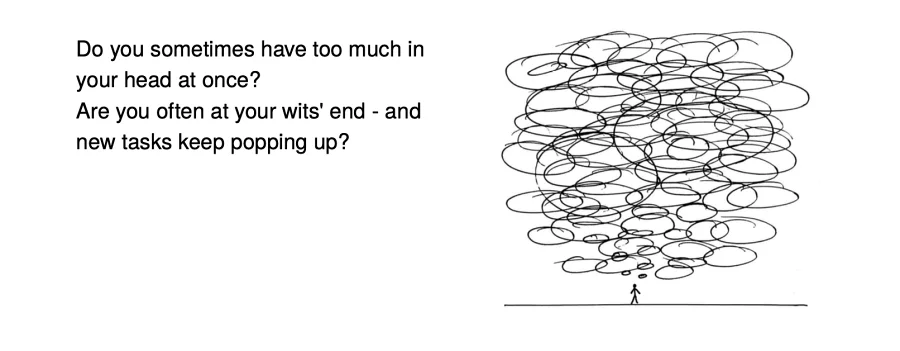
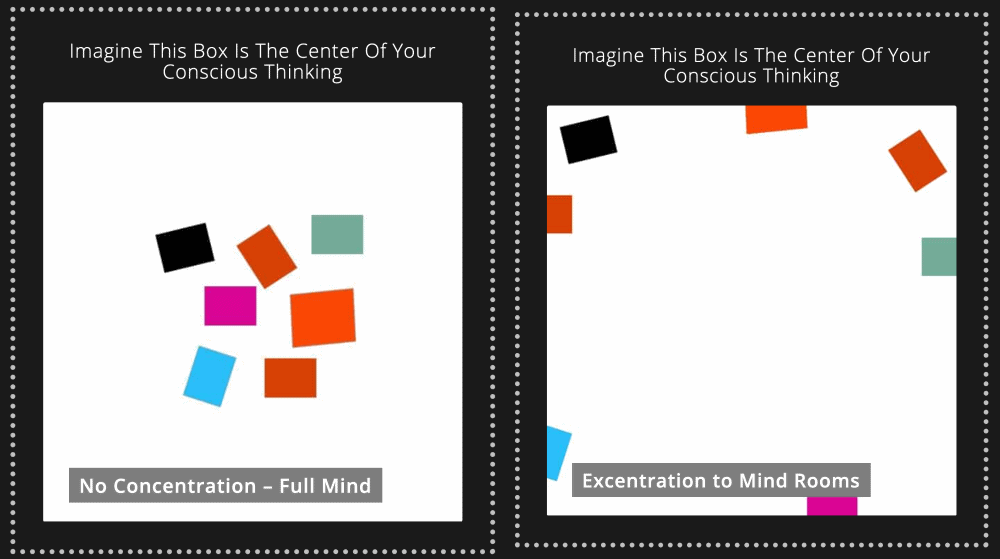
There can be the thought of hunger coming up, and at the same time a thought of a postponed task, plus the thought of another book you've wanted to read for a long time, and also, for example, thoughts of circumstances you'd like to change, the question why the neighbor is mowing his lawn right now, or the dog is barking.
Such accumulations of thoughts are normal. And not very often useful.
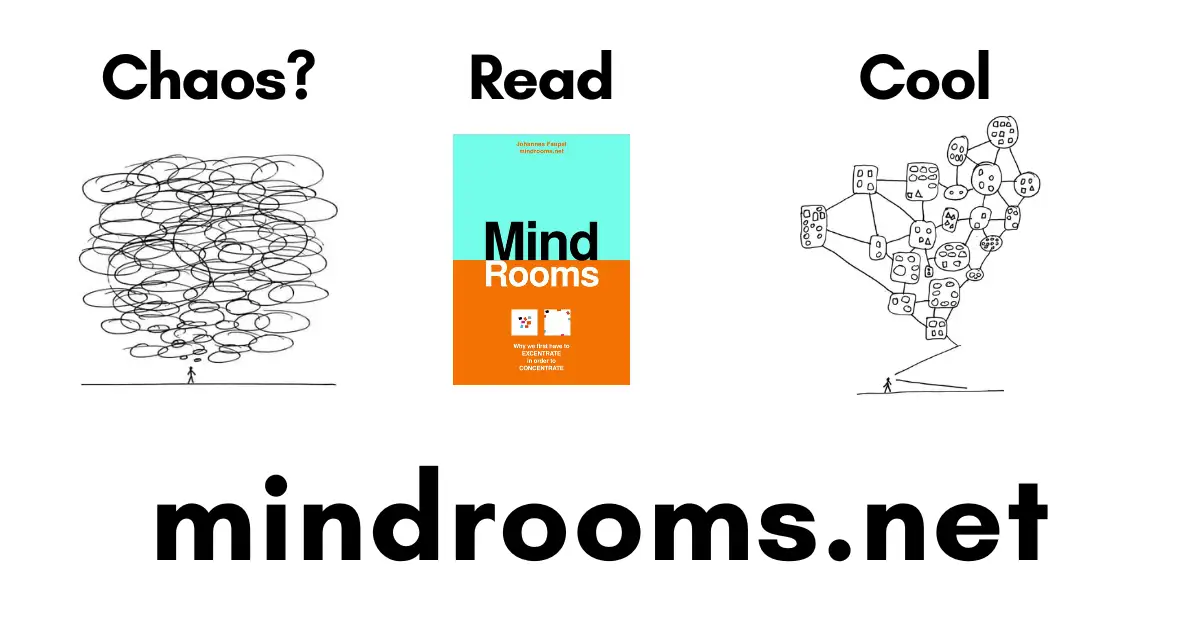
Because a cluttered attention space can cause you to stumble over thoughts, get stuck on them, get tangled up, lose the thread. Who can keep track of everything when everyone is talking at once?
In the head, it can look like an apartment where there is no furniture, not even rooms. You can't pick up a thought with your hands and carry it down to the basement. But the idea of carrying is true. In thoughts, you can bring thoughts to places where they are well-kept until the moment when there is time for them.
That takes nothing more than places. Rooms in your mind.
The key insight
If a parking garage is occupied, I can't drive in. Period.
No matter how much I want to, the parking garage is occupied. All the will in the world is useless.
And what if I try to drive into the garage at speed and push the other cars? Then there will be fender benders and excitement from the owners of the other cars.
You also can't just come in with a forklift and haul away what's in your head. Not in your head, and not in a parking garage.
The conscious will says: "Concentrate at last! Get a grip." But how is it supposed to work?
You need another way. Here it is: Excentration.
How it works
Build a space for each type of thought
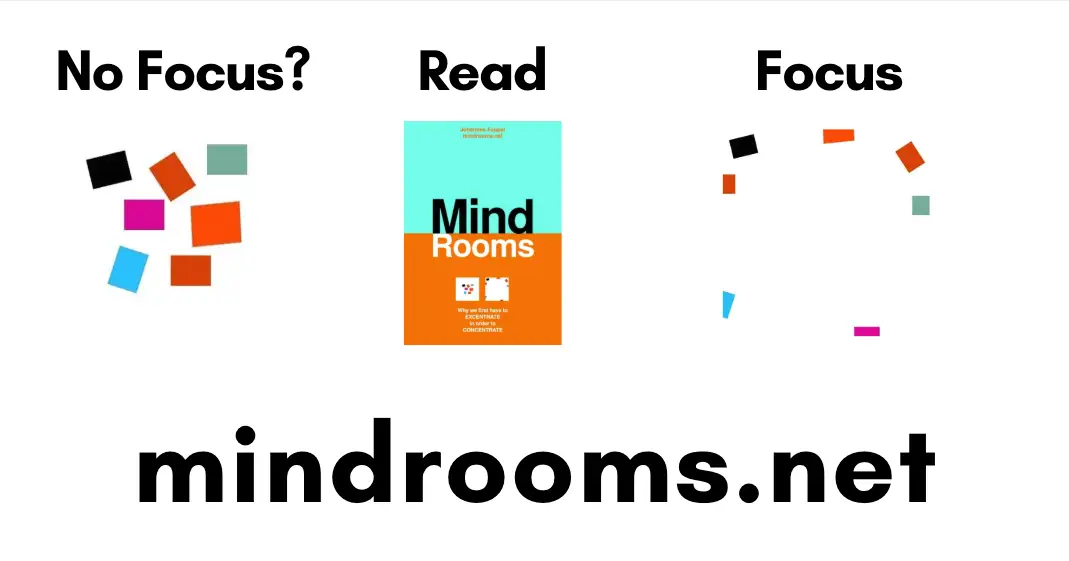
Build a special space in your mind for each type of thought. Then invite any thoughts that arise to take a seat in the ideal thought space. Assure them that you will come later and make time for them. For now, focus on Topic A.
Build rooms
Give different types of thoughts their own named spaces in an imaginary apartment. Each room has a job.
Invite thoughts to their rooms
When a thought appears, tell it: "I see you. You go to the Waiting Room. I'll come back." And come back.
Your Attention Center is free
"Every thought gets its place here. I cannot expel thoughts — but I can give them rooms."
The rooms
Every thought gets a home
The apartment has rooms for different types of thoughts. Some you visit regularly. Some you walk past and nod to. Some are full of very strange residents.
Attention Center
The main room. What you're dealing with right now. This is what Excentration clears.
Waiting Room
For thoughts that are right but not on the line right now. They're dry and clear here, and they'll wait.
Workroom
Unfinished thoughts go here. My faithful companion in this room is my intuition. She takes care of everything while I'm away.
Rumple Chamber
For the mosquito thoughts — the annoying, absurd, frightening ones. Since I invited them in, they've quieted down.
Provocation Room
For charged thoughts that would be dangerous if simply left lying around openly. Secured, not suppressed.
Balcony
From every room I have direct access to my balcony. The view there is always outstanding — even in fog and in the darker phases of life.
Ballroom
Instead of champagne, there is a large portion of gratitude for each thought present. Sometimes the celebration is so exuberant that other thoughts can hardly be perceived.
Bathroom
I put thoughts in the tub to relax them. Some I cut the hair or the beard. The thought bath is a healing place.
…and more
Museum, Gallery, Surprise Room, Fuse Box, Recyclables Room, Room for Retreat — each with a purpose.
Who uses Mind Rooms
Paradoxically, virtues and strengths can lead people to hold on to too many thoughts
Loyalty. Conscientiousness. Creativity. Diligence. Determination. These are virtues. Unfortunately, these virtues are often confused with disadvantages.
The creative person who is afraid of losing ideas. The conscientious person who can't stop thinking about the family while preparing a presentation. The determined person who keeps going when the fuse should have blown.
- People with ADHD who have too many thoughts competing at once
- People with intrusive thoughts looking for a way to stop fighting them
- Anyone stuck in a loop — replaying the same scene, unable to exit
- People preparing for something that requires focused attention
- Those who've tried meditation and found it doesn't fit how they think
Mind Rooms is not a therapy. It is a practice-based self-help tool that can complement therapeutic work. When professional help is needed, please seek it.
The science
For every once-experienced pictorial idea there are traces in the brain
The book grew from therapeutic practice, not from a laboratory. But the rooms map remarkably well to what neuroscience knows about thinking. The Attention Center corresponds to working memory. The Rumple Chamber works because of the thought suppression paradox — fighting a thought makes it louder. The Balcony is metacognition made spatial.
Make your mind rooms strong images. Paint them with bright colors. Then it will be easy for you to practice Excentration.
About the author
Johannes Faupel
Get the book
A picture book for daily life
Mind Rooms
Why we first have to Excentrate in order to Concentrate
50 pages. Read in one sitting. Start using the rooms today.