The Rooms
Welcome to a guided tour. You can keep your shoes on. Every thought gets its place here. I cannot expel thoughts. Something else, however, is quite possible: I can give thoughts rooms so that they arrange themselves in such a way that I get my head free for those matters to which I want to devote myself — right at this moment.
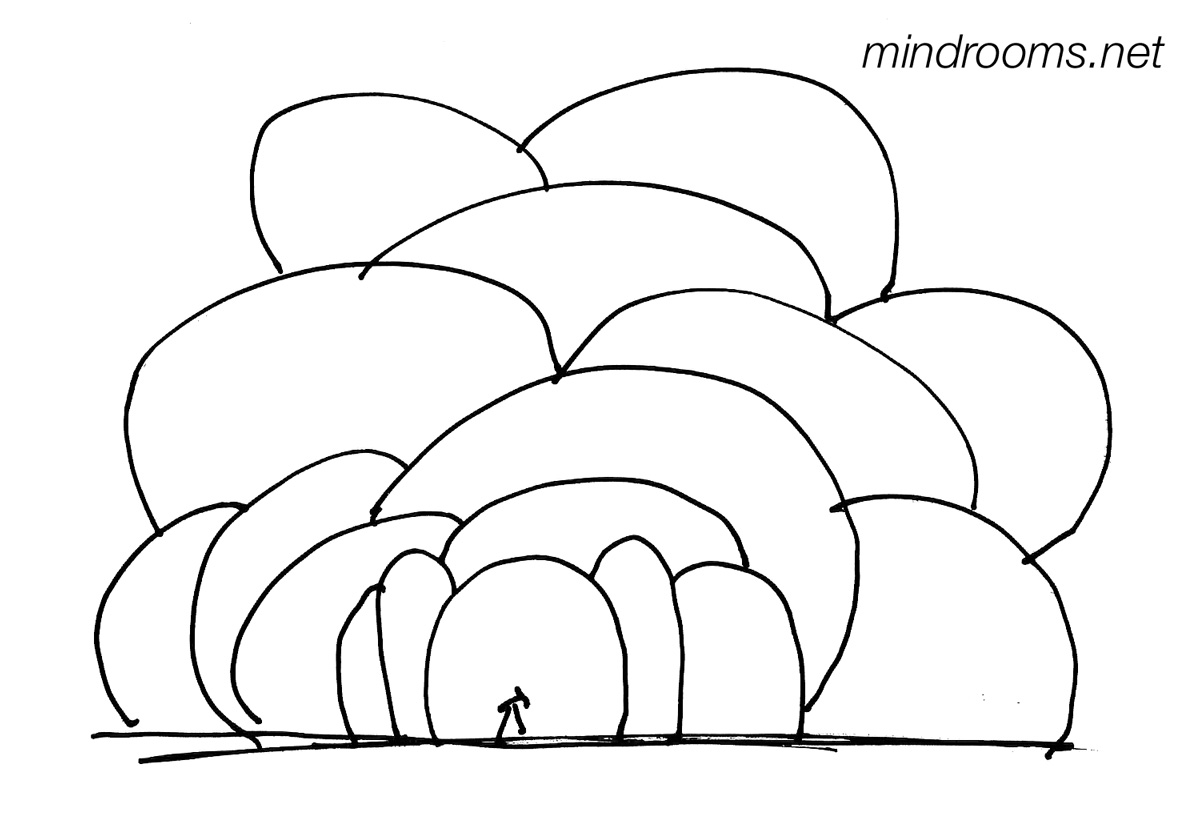
Mental Hallway
The hallway that connects all the rooms is made of a mind-guiding material. Within fractions of a thought I can be anywhere in my mind rooms. Sometimes I have the impression it goes even a little further when I dream. But that can also be deceptive.
You can imagine a mental hallway as the lines between the rooms.
Attention Center
Straight ahead is the main room of my Mind Rooms: the Attention Center. Here is what I have in mind at any given time, what I am dealing with. The Attention Center is the topic this whole concept is about.
It holds one thing. Not two, not three. Just one.
In cognitive science, this maps to what researchers call working memory — the limited-capacity mental workspace for your current task. Excentration works precisely by keeping only one item here at a time.
Waiting Room
Here I bring the thoughts that are right but not on the line right now: for example, the thought of booking the next summer vacation. I bring this thought into my waiting room. There it is dry and clear.
Occasionally, I imagine that the waiting thoughts would exchange themselves there and get on without me. But that can also be deceptive.
The Waiting Room externalizes executive function — particularly the capacity to prioritize, defer, and sequence. For people whose internal executive function is unreliable, as it often is in ADHD, the Waiting Room provides scaffolding.
Workroom
Next I will show you my workroom. This is where I put all the thoughts that haven't been thought through yet. These include professional projects, a book other than the one you're reading, tomorrow's and tomorrow's future.
The special thing about this workroom is that none of the thoughts is left alone there. Around the clock someone is there for all thoughts, developing them further, adding possible solutions, writing "revise" to one or the other and "discard" to those that are not to be continued.
I am relieved that all thoughts are so well taken care of, there, in my tidy workroom. The faithful companion in this workroom is my intuition. I bring her my unfinished thoughts like parents bring their children to childcare.
Rumple Chamber — for all "anankastic" and "evil" thoughts
Not long ago I would have given the next room a wide berth with you, even concealed the fact that it existed at all. But since I have settled into my Mind Rooms, I will let you see into this room as well. Feel free to go in.
It is my rumpus room. Here are the thoughts I used to want to get rid of but couldn't. Like mosquitoes, these thoughts used to circle around the clock in my attention center, constantly biting me. By those mosquitoes, I mean the annoying, the absurd and frightening thoughts that seemed to come out of nowhere and caused me a lot of trouble.
"How could you think such a thing!" I used to think. But that was exactly how I cemented such a thought in my mind internally. The more I tried to dispel unwanted thoughts with the power of other thoughts, the more the unwanted thoughts felt at home with me.
Since I invited them into the junk room, they have quieted down. I told them that they could stay here for all I care. Some of them turned their noses at me, and one of them provocatively stuck his naked butt out at me. One of these strange thoughts even took off his head and played soccer with it. I left it at that.
When I walk past the rumpus room today, from the outside it sometimes sounds as if the absurd thoughts are laughing at each other, chasing each other through the rumpus room. But that can also be deceptive.
This works because of the thought suppression paradox: attempting to block a thought increases its frequency. By accommodating rather than suppressing intrusive thoughts, the Rumple Chamber circumvents this entirely.
Provocation Room
For my safety there is also a provocation room. Here material is secured that would be dangerous if it were simply lying around openly in the mind room: burdens that have not yet been released, supposedly unpaid bills, suspicions of disadvantages.
Moreover, in my provocation room are the loaded thoughts: the ideas of arguments that could be won with mental clout, with brilliantly delivered, razor-sharp words (an illusion, of course).
Today, when I discover such a thought that could mean danger for me or others, I release it into the provocation room. There, many such thoughts gradually dissolve on their own — almost as if they compost on their own.
Balcony
From every room I have direct access to my balcony on the way through my mind high-speed corridor. My balcony goes all the way around the Mind Rooms. So I can see in every compass direction from every spot. The view there is always outstanding, because there is only clear view — and that even in fog and in the darker phases of life.
The balcony has four benefits:
- View of distances. From my balcony I can see to points that I have set as targets. I can see from above what distances will have to be covered until I reach my destination.
- Cooling. Thoughts that are too fast or too hot slow down by themselves outside so that I can follow them, and they cool down pleasantly. When they have cooled down, I can invite them back in.
- Seeing your own thoughts from outside. I can look at my own thoughts from the outside. This view from the outside has helped me many times to understand and change something. Once when I saw the thought of excessive helpfulness from my balcony, behind the thought sat a child, about five or seven years old, who wanted nothing more than appreciation.
- When the Attention Center gets crowded again. When it occasionally gets too crowded again in my attention center, I let the company there and go with my attention to the balcony. Simply to take a breath and for the circumspection.
This is what psychologists call metacognition — observing your own thinking from the outside. The balcony makes it spatial and navigable.
Recyclables Room
At the end of the hallway I have my recyclables room. This is where thoughts of past events are registered. In the past, I was still of the opinion that only the beautiful, the good events should be kept. All thoughts of sad and unpleasant events should have stayed outside. That's how I used to think.
When my Mind Rooms gradually set up and designed themselves, I noticed how much I also owe to the thoughts of the survived defeats, mistakes and errors, because today I know what I could learn from them and continue to learn.
All the thoughts of past events are more and more added together in this recyclable space to form a kind of life book in which I can look things up.
Gallery
In my gallery of thoughts are stored the thoughts of events which still impress me today. There are images that look like photographs. Others look like painted, like room-filling stage sets of great operas or movie sets. There are also beautifully colored memories that look like pop art.
From other people and from myself I get pictures that have their places of honor in my gallery. I never run out of space, because my gallery stretches over a stretchable imaginable space, which at its farthest ends reaches roughly from Alaska to Africa.
Whatever I'm doing at the moment, however life is playing and whatever the weather may be outside — a tour of my gallery brings me back to me and nearby to good thoughts.
Museum
The museum is an important space. Here thoughts of those incidents are kept which have long passed and yet remain part of my reality, my life.
I often experience people who would like to please erase certain parts of their lives. But deleting is not possible — integrating is the way forward. Thoughts cannot be commanded, certainly not an emigration.
Once brought to a place of honor in the inner history room, they usually leave you alone. Here, thoughts of exciting events that now belong to the past are stored. These include many beautiful life moments, but also arguments, missed opportunities, dissolved relationships, experiences of loss — everything that has passed in time, I bring here. I can look at it if necessary. Past is past, and so it is good.
Ballroom
There is not always time for big parties. After all, you can't keep graduating from high school and turning 40 or 50. Everything that there is to celebrate without invited persons (thoughts) is celebrated in the festival room of my Mind Rooms: the renunciations of provocative statements, a text patiently written to the end, a proof of blessing, a successful sauerbraten, a clarifying conversation, the luck with the life that is lent to me.
Instead of champagne, in the ballroom there is a large portion of gratitude for each of the thoughts present. Instead of a toast, an encouragement.
Bathroom
Yes, there is also a bathroom in my Mind Rooms. Here I nurse my thoughts. Especially those that may have fallen a little short. I put them in the tub to relax them. Some I cut the hair or the beard, if they have put one on.
The thought bath is a healing place. It is also where the injured thoughts are taken care of.
When I stand under the real shower in the morning together with my thoughts in my inner bath, I feel the less useful thoughts flow away and make room for other thoughts.
Surprise Room
There is also a surprise room in my Mind Rooms — a mirror cabinet where thoughts can look at their reflection and even see behind themselves. Some of the mirrors are distorting mirrors.
If a particularly inflated thought places itself in front of such a distorting mirror, it appears even more inflated and bursts at its own sight. Sometimes I have the impression that I could listen to the inflated thoughts bursting.
Fuse Box
Right by the entrance is the fuse box. When you open it, what do you see? There's a big fuse that says "ten over." This fuse always flies out automatically when it gets too much for me. Only after a break can I turn it back on and continue. That's my built-in burnout prevention.
Another fuse is labeled "Back Pain," one "Dizziness," one "Headache," one "Tummy Grip," and one "Chest Pressure." Most of these fuses date back to the days when things were once in my Mind Rooms, when chaos in the head was the order — or rather the disorder — of the day.
Room for Retreat
With so much to do, of course, there's also recreation. In the retreat and rest room, those thoughts can relax that I struggle with again and again for a variety of reasons. Thoughts that used to give me no peace can retreat here. Some, by the way, seem to do so at the exact time I'm sleeping.
The thoughts presented here are just sketches. One or the other may come together in a similar way to form a mind room that is coherent for you, others may not apply to your situation at all. It doesn't matter which of the room ideas you like more and which less. It is only about one thing: if now or soon images of a mind room appear before your inner eye which fits to your thoughts and which gradually takes shape — this can have a useful effect on your everyday life.